Disclosure: This post may contain affiliate links. If you make a purchase through these links, I may earn a small commission at no extra cost to you. See my full disclosure.

Writing Through the Noise: Why I Started Blogging as a Superintendent
Working in subsidized housing means constant pressure, unexpected emergencies, and emotional weight that doesn't just disappear at 4:30 p.m. I started blogging not because I had all the answers, but because I needed somewhere to put everything down and make sense of it.
I don't think I ever sat down and decided, "I'm going to start a blog to cope with work stress." It just sort of happened. One night after a particularly long day, multiple work orders, a tenant dispute that went nowhere productive, and a piece of equipment that decided to quit mid-afternoon. I opened my laptop and just started writing. Not a work order note. Not an email. Just writing.
It wasn't organized. It wasn't polished. But it felt better than scrolling through my phone or sitting there replaying the day in my head for the hundredth time.
That was maybe a couple of months ago. I've kept it up since then, not every day, but regularly enough that it's become part of how I process this job.
The Weight That Doesn't Leave at 4:30
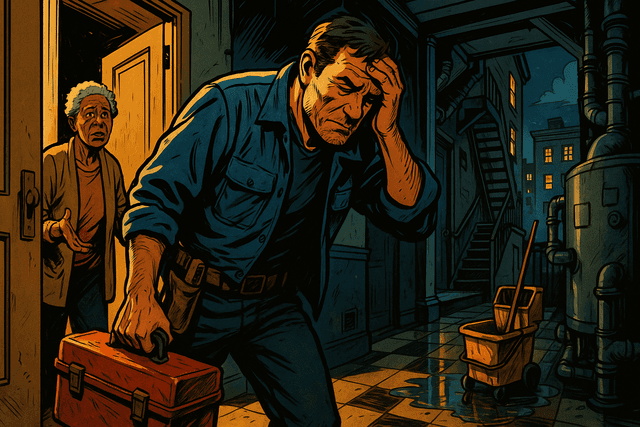
Here's what they don't tell you when you take a superintendent role in subsidized housing: the emotional load doesn't clock out when you do.
You can lock the office door, walk away from the building, go home and cook dinner with your wife, but part of your brain is still there. You're thinking about the tenant who came by three times that day asking about a transfer request you can't expedite, it's not even under your department. You're replaying the conversation with the maintenance worker who's clearly burned out but won't say it directly. You're wondering if that boiler repair is actually going to hold or if you'll be dealing with it again next week. My building just switched to A/C mode, then boom, the whole building has like the surface of the sun.
It piles up. And it doesn't matter how experienced you are or how good you get at setting boundaries, some of it still comes home with you.
I'm not talking about genuine emergencies. Those I can handle. There's clarity in an emergency. Something's broken, you fix it, you move on. It's the other stuff. The unresolved tenant issues. The systemic problems you can see but can't solve. The policies you have to enforce even when they don't feel right. The tenants who are struggling and there's only so much you can do.
That's the weight. And you can't just leave it in the boiler room.
Writing as a Pressure Release
I didn't start blogging with any grand plan. I wasn't trying to build an audience or position myself as an expert. I just needed somewhere to put things down that wasn't a work email or a conversation I'd have to manage.
Writing forces you to slow down and organize what's rattling around in your head. When you're dealing with thirty things at once all day, work orders, tenant calls, contractor follow-ups, equipment checks, your brain operates in reactive mode. There's no time to actually think through what happened or how you feel about it.
Blogging gives you that space. You sit down, pick one thing, and work through it. Sometimes it's a maintenance problem I'm trying to solve. Sometimes it's a frustrating situation with a tenant that didn't go how I wanted. Sometimes it's just noticing a pattern I hadn't articulated before.
The act of writing it out, turning the noise into sentences, creates distance. It's not bouncing around in your head anymore. It's on the screen. You can look at it, shape it, decide what it actually means instead of just carrying it.
It's not therapy. I'm not pretending it is. But it helps.
Turning Chaos Into Something Useful
One thing I've noticed: writing about a problem often helps me see it differently.
I had a situation a while back where a tenant kept submitting work orders for the same issue, said the unit was too cold, the heating system isn't working properly. We'd check it, test the system, adjust the thermostat, close the work order. Two weeks later, same complaint. This went on for months.
I was getting frustrated. The tenant was getting frustrated. My and my maintenance person are both tired of going back to the same unit for what felt like nothing.
I started writing about it one night. Not to publish anything, just to think through it. As I was typing out the timeline, something clicked. Every complaint came right after a cold snap. The system was working fine, but the unit was on a corner, older windows, and the tenant had mobility issues and kept the heat lower to save money until it got really cold outside.
It wasn't a mechanical problem. It was a combination of building design, tenant behaviour, and a communication gap. Writing it out let me see the whole picture instead of just reacting to each work order as it came in.
I still didn't have a perfect solution, I talked to the tenant, explained what was happening, adjusted expectations, and flagged the unit for a future window replacement. But at least I understood it.
That's what writing does. It lets you slow down enough to actually think.
The Posts That Don't End Cleanly
Not every post I write has a solution at the end. In fact, most of them don't.
I've written about staffing problems I don't know how to fix. About tenant situations that remain unresolved because there's no good option. About equipment failures where I did everything right and it still went wrong.
Those posts feel the most honest. Because that's what the job actually is most of the time. You do your best, you try different approaches, and sometimes it just doesn't work out the way you'd like. Writing about it doesn't change that. But it helps me stop carrying it around like a personal failure.
There's something freeing about putting something out there and saying, "I don't know. This one's still messy." You don't have to have all the answers. You just have to keep showing up.
Why I Keep It Public
I could journal privately. Some people do that and it works for them. But I chose to make it a blog, and I think that matters.
Knowing someone might read it makes me write more clearly. I have to explain the situation, provide context, think about whether what I'm saying actually makes sense. It's not just venting into a void, it's trying to communicate something that might be useful to someone else in the same position.
I've had a few other superintendents reach out over time. They'll send a message saying they dealt with something similar, they tried what I mentioned and it helped, or they have a solution my problem. That's not why I started, but it does make it feel more worthwhile.
And honestly, it's a reminder that I'm not the only one dealing with this stuff. Every superintendent I know carries some version of the same weight. Writing about it out loud, even in a small corner of the internet, makes it feel a little less isolating.
Blogging also keeps me connected to my other favorite, applications development. I write the code for website, pushes to Github, manages my VPS server, debugging, rewriting codes, debugging again, adding features, redesign, troubleshooting, A/B testing etc.
It's Not a Fix
I don't want to oversell this. Blogging doesn't solve the underlying issues. It doesn't make the job less demanding or the stress disappear. It doesn't fix broken systems or give you more time in the day.
But it gives you a place to put things. A way to process what you're dealing with that isn't just replaying it in your head at 11 p.m. or unloading on your partner every night after work.
For me, it's become part of how I manage this job long-term. The same way running helps reset my head, or cooking gives me something to focus on that isn't work, writing does something similar. It's a tool. Not a cure, but a tool.
If you're in a role like this and you're feeling the weight, maybe try it. Open a doc and just write about your day. About the thing that's bothering you. About the problem you can't figure out. See if it helps.
It doesn't have to be public. It doesn't have to be good. You're not trying to build a following or sound smart. You're just putting it down somewhere outside your head.
That alone can make a difference.
Loading reactions…
Comments
New notes are reviewed before they appear. Be kind and on-topic.
Loading comments…
Related posts

Nursing a Knee Injury: Week Two Update From a Superintendent Who Can't Afford to Be Sidelined
Two weeks into a knee injury and I'm making progress, the pain is easing up, I'm being smarter about how I move through the building, and I'm keeping one eye on eventually getting back to running. Here's an honest update on what this kind of recovery actually looks like when your job keeps you on your feet all day.

We Drove North and I Left the Building Behind
Sometimes the best thing you can do for the building is leave it. My wife and I packed the car, pointed it north, and I tried something I'm genuinely not good at: switching off. Here's how that went.
The Fine Line Between Compassion and Burnout in Working as a Building Superintendent
Nobody warned me that the hardest part of this job wouldn't be the boilers or the work orders, it would be the people, and how much of their weight I'd end up carrying home. This isn't a post about solutions. It's about naming something that doesn't get named enough in this line of work.